We were in the town of Ernakalam, state of Kerala, in south-west India for Christmas 1990. This part of India was settled many years ago by Portuguese sailors which is why the state has a high percentage of Christians. There is also an ancient Jewish presence, especially in Fort Cochin, a ferry ride from Ernakalam. Kerala is a prosperous state, and has the highest literacy rate in India. People seem very laid back, open and friendly, a great place to visit, especially at Christmas time. 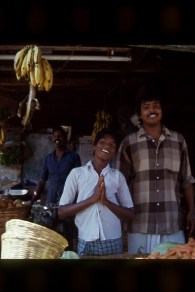 The shops are full of colorful Christmas decorations, shiny stars and streamers.
 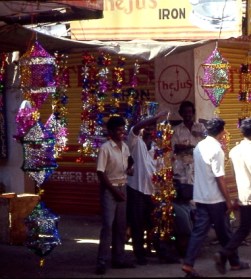 Shopkeepers are friendly and full of smiles and “Merry Christmas” greetings.
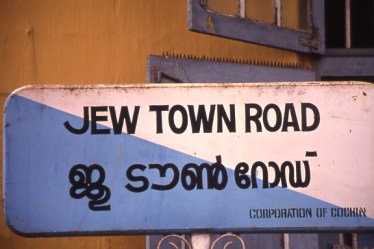
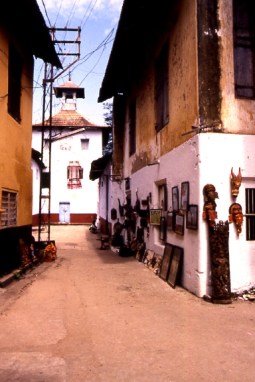
On Christmas Eve day we visited the beautiful little town of Fort Cochin. Our short ferry ride took us past anchored cargo ships, rough-hewn log canoes and square sailed fishing boats. The town itself consisted of narrow winding streets, white washed, red-tiled roofed houses, antique and curio shops, people waving from doorways, goats grazing in the dirt and people out for a Sunday stroll.
 When we reached the waterfront we found, stretched along the channel between two islands, ghostly Chinese fishing nets.
 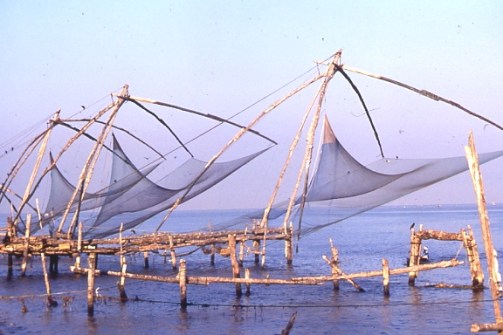 Their black mesh stretched within the framework of long bent logs which were weighted at one end with large rocks held by long heavy ropes. The whole apparatus of nets was lowered into the channel by unweighting the back-end. After 5-10 minutes it was pulled up by 4-5 men straining on the ropes until the weight of the rocks took over and helped lift the catch out of the water.
 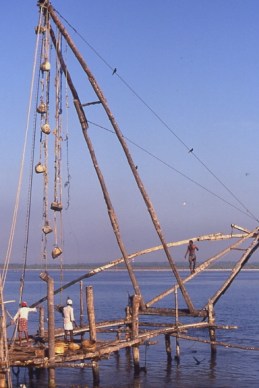 Up and down they went along the line of nets like giant slow-moving oil well pumps .
Walking inland again, we found the oldest church in India, St Francis, where Vasco De Gama had originally been buried.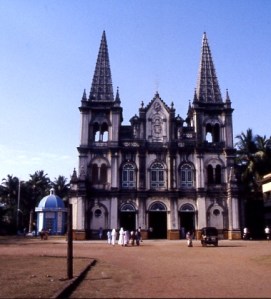
The night of Christmas Eve we were treated to a Katha Kali classical Indian dance drama in the home of Mr. Devan. He has been putting on this performance, in his home, every night, for the past twenty-one years. His father danced the Katha Kali until he was 97 years old, and this tradition has been in his family for four generations. Katha Kali is a form of Hindu Temple dancing. It is very symbolic both in make up (which is all Ayurvedic) costume, as well as facial expression, hand movements and dance. The small audience sits on folding chairs in an intimate dark room adjacent to the stage. The evening starts with an explanation of the dance, the make up etc, then we watch in fascination as the men put on their makeup and costumes, slowly transforming themselves into their classical Indian characters. 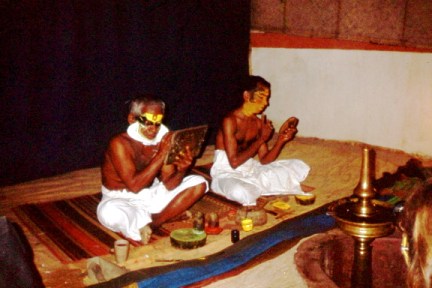 The performance includes music, vocals, hand and facial gestures to express ideas, and footwork.
 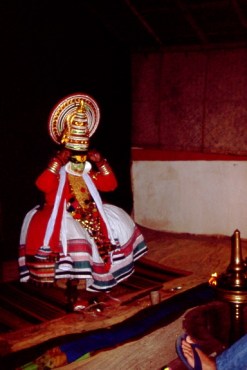 Kathakali also incorporates movements from the ancient martial arts and athletic traditions of south India.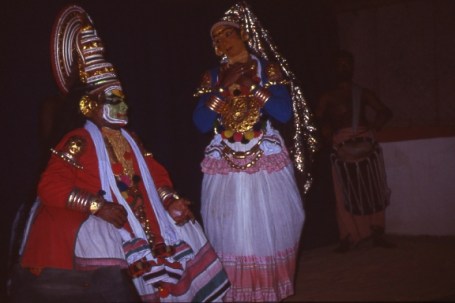
It was a fascinating way to spend a Christmas Eve!
Christmas day turned out to be just as much fun as the evening before. We caught a ferry to Kottyam to see some backwater areas of Kerala. While waiting for our boat, we met a really sweet 83-year-old man who introduced himself to us and wished us a Merry Christmas. His name was Raphael and he had been a servant all his life. He served his British “Master” for 35 years and an American one for 22 years. Between those two jobs he also served people from Germany, Japan and China. He was a highlight of our day.
The boat trip was fascinating. Once upon a time there was a huge lake which stretched for many km down the coast of Kerala between the towns of Ernakalam and Allepy. The human developers came along and subdivided this lake just as they would solid land. They built rock sided water lanes, water roads and water highways.
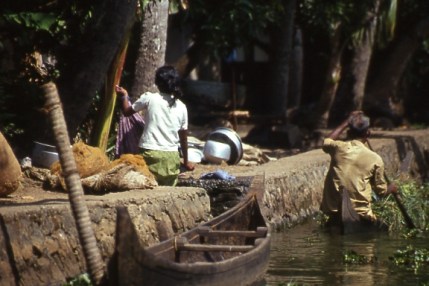
On the “sidewalks” by these “roads” they planted palm trees which stand in long rows like stilt legged, plume headed aliens gathering for a parade. Behind the side walks were the huge green “sub divisions” broken into plots which were fenced off from each other by earthen dikes. Some of these “subdivisions” had their own narrow water lanes as well, but most had only paths. These developments were populated by millions of green beings called rice plants. Working for these popular green beings were other beings called humans, whose multicolored plumage stood in sharp contrast to the green uniform of the rice. These humans were allocated a 10-20 meter strip of land between the side-walk/water road and the development. There they built their crude palm thatched houses, raised their brown children and washed and bathed at the edge of the “road”. 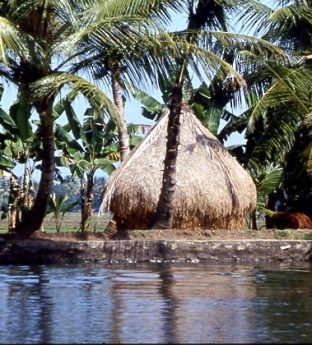 They also built different kinds of vehicles to “drive” on these “roads. Most families owned at least one, long, narrow wooden vehicle which they drove with poles.
 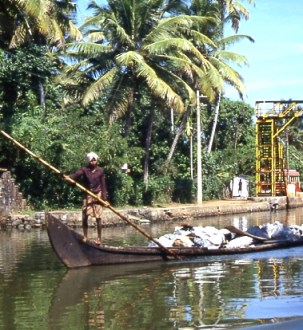 Some families had longer boats, kind of like our trucks, so that they could take their produce to market, some even had curved bamboo covers on them.
 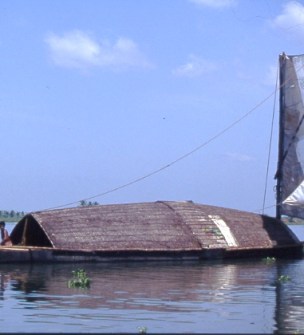 There were also a few water buses which took the humans to and from the mainland to purchase supplies. Some of the smaller roads in these developments had not been well maintained and were so rutted with weeds that the “vehicles” could hardly get through. They looked as if they had been carpeted in green. The “side walks” on some of these “roads” were also crumbling and the “road” had seeped in and destroyed the rice development. The infrastructure was crumbling.
It was so interesting to see how these people lived a very different kind of life then we would ever imagine.
Until next time!! Be fearless in imaging a different kind of life for yourself!!
 Terra Lyn Joy
Another great story Terra! The caves look amazing! Sky was lucky he got to keep his illegal photo, oh and the rocks, so funny! I was trying to imagine what it must have been like taking all the short cuts. That sounds like such a sweet gift to have that experience. The world would be such a different place if we could all see each other as ONE!
LikeLike