Berastagi is a smallish city deep in the mountains of northern Sumatra sitting at the foot of the active volcano Mount Sibayak. It is a beautiful area of farms growing huge fruits and vegetables in the rich volcanic soil. Our guesthouse, Wisma Sibayak, was run by a friendly, very enterprising, family who catered to travelers. The rooms were basic but the proprietors could arrange just about any kind of outing one could wish for. There were jungle treks, traditional weddings, funerals and festivities, transportation, you name it and they could arrange it. A bulletin board in the common room was chock full of information about local treks, proposed trips, and village events.
One of the events we chose to attend was a wedding that was being held at a Karo village a half hour north of where we were staying. On the big day, two Bemos (large vans) were procured to transport 20 of us travelers up the bumpy gravel road to the big celebration.
When we arrived, the bride and groom were seated in the middle of a grassy area of the village center surrounded by a U-shaped structure where people from two other villages were seated. At the front of the grassy area, adjacent to the road, was a wooden shelter raised above the road. Painted relief carvings adorned a border around the base, the pointed roof rose high and at either end were carved animal heads with horns. The villagers sat on woven mats under the metal roofed shelter talking, eating peanuts, tending children and watching the proceedings in the middle. We were instructed to remove our shoes, and were guided to seats under one of the shelters. Behind us, several men cooked vegetables, rice, and pork in huge iron woks over open, smokey fires.
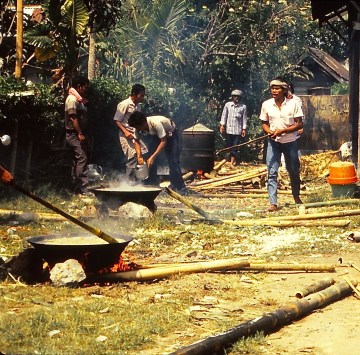
The heat from the fire was intense, and could be felt warming the air in the surrounding area. The food bubbled away and made Sky feel good that his food would be well cooked.
The bride and groom were both dressed in maroon clothes with fine lines of gold-colored thread woven into the fabric in geometric patterns. Gold ornaments dangled from their cloth wrapped heads and from around their necks.
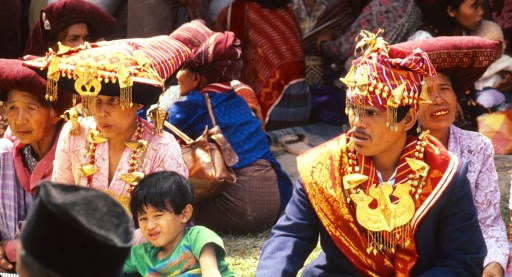
The couple had actually been married for several years and had children, but at the time of their marriage they had no money for a traditional wedding. The families of the bride and groom were seated next to the couple and passed money back and forth as they negotiated a dowry for the bride. A man, who was seated among them, described the happenings to the audience with the aid of a microphone. The bride price was finally agreed upon and the money was paid to the bride’s family. Rice was placed on the couple’s headdresses, their children were dressed in new clothes, and a ceremony of some sort was performed. 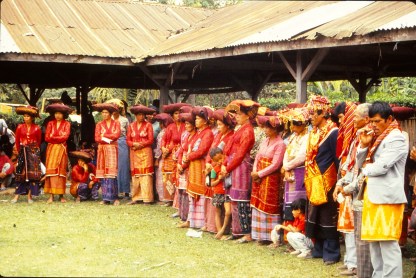 The couple then stood and joined a line of people who must have been the wedding party as they were dressed similarly but in a different color red and without as much gold. The women wore maroon and red blouses, and sarongs, with tri-cornered headdresses constructed by folding the gold threaded cloths around and on top of their heads.
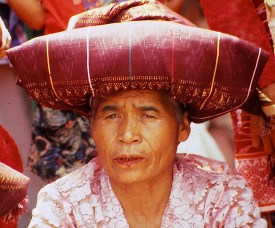 The men wore the same pieces of cloth as scarves around their necks.
Various people got up to speak, with the speeches seemingly going on for hours, while the spectators socialized with each other paying little attention. Many of the speeches, were wrought with emotion and tears. When the last speech was given, the people milled about with men and women staying separately in their own groups.
We were told that it was not common for men and women to socialize in public but were content being with their own sex. Men of similar ages gathered in groups many holding hands with each other. This is the custom here and is not viewed as a homosexual gesture.
During the extended negotiations and speeches, our guide took us walking in the village to see the long houses. These are large wooden, rectangular timber-framed structures, built with no nails only mortice and tenon joints and wooden pegs. They are raised above the ground on wooden posts set atop concrete columns. They have bamboo walls and palm leaf roofs.
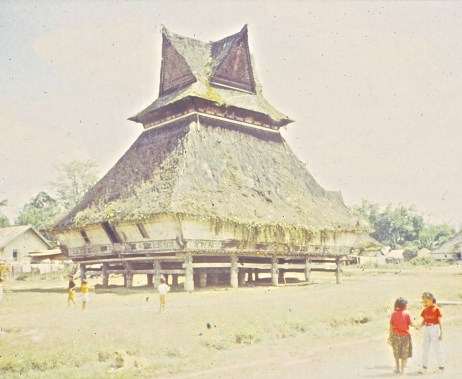
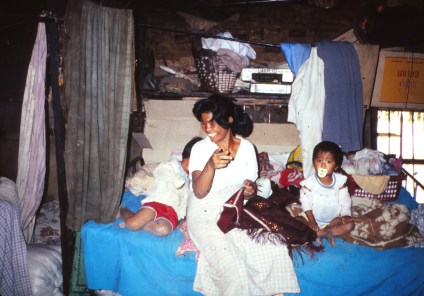
Several families live in each house each having a small semi-divided cubicle which consisted mainly of a bed and few possessions. The animals and firewood were kept below the house while the people sleep on the first floor. A platform, like an old-fashioned hay loft, ran along either side, and the roof towers above were blackened by the smoky fires that were burned within. We had a very warm welcome by one family who was at home when we walked through the house.
When we returned to the wedding the speeches were still in progress but the blank faced bride and groom were now standing with the guests who laying gifts of rice, chickens, and multi colored pillows wrapped in Rattan mats at their feet. Wrapping up with some final words, the new Mr and Mrs smiled for the first time and went to greet the people who were standing around them.
The cooking of the food had been completed and was ladled into hundreds of worn porcelain soup bowls. The bowls were then placed on a mat under the shelter and stacked high in a pyramidal shape.
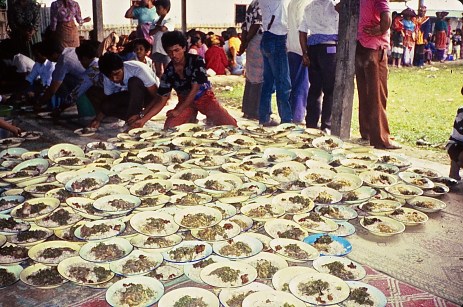
An assembly line of servers formed and food was quickly passed, by this chain, to the hundreds of people who were gathered for the wedding. A prayer was spoken and then we followed the lead of others and dug into the delicious mess with our fingers. Servers passed through the crowd refilling people’s plates as needed and when we were finished we washed our fingers in shallow bowls of water which had been handed out prior to the feeding frenzy.
Stomachs full, the first of our group departed, leaving us and a few others stuck waiting for a Bemo for almost an hour. While we waited, the Headman invited us to sit in a tea shop where we passed the time talking to some other Americans we had met. When we finally got our Bemo we were squashed in with some local women who we enjoyed joking with in our broken English/Indonesian. They asked us if we would like to see some dancing at their village, we said “sure” and our guide had the Bemo stop. We arrived in time for the last dance and were invited to participate. I was the first to volunteer, then many of our group joined in while a woman in the middle led us. There was a line of women on one side and a line of men on the other. The dance started off slowly, we dipped our bodies, moving our outstretched hands with palms down then up to correspond to our body movements. This was done slowly and rhythmically by the locals, but we were not so fluid. The music than sped up and our movements became more jerky. The dance ended with the women motioning the men to come toward them and then without touching, pushed them away. The crowd was roaring at the round eyes stumbling through the dance but we had a great time.
Yet another wonderful day interacting with another culture of human beings. We are all the same, no matter the color of our skin, our religion, where we live in the world, we are just all human with the same feelings of sadness, joy, and love.
Until next time, be fearless and wild in all you do and dance, dance, dance!!
 Terra Lyn Joy
Love this Terra! So interesting how our cultures vary around this big wide world. The “happy couple” doesn’t look very happy. 😉 I find it interesting that they have weddings and funerals as tourist options.
LikeLiked by 1 person