As a child, I had been a great fan of the National Geographic magazine and the many cultures it featured in its issues. The one that most intrigued me was the Papuan culture of that great island off the southeast coast of Australia. It was a wild, mountainous land with hundreds of tribes, each with their own culture and language, inhabiting the valleys and hills, totally cut off from each other due to the rugged terrain. I had been fascinated by the fierce looking painted faces with bones through their noses, and the muscular black men in loin cloths carrying spears and bows and arrows. So many of the cultures I had been fascinated with in my youth were either dead or dying in the 1990s. I was hoping that there was still something left of the wildness of the Papua New Guinea culture I had felt from those photographs.
“The Land of the Unexpected”! That is the motto for Papua New Guinea and that Easter Sunday of 1990 we began our odyssey right into the middle of it!
Early in the morning we were transported to the airport by our guest house hosts, where we began our airport sitting lesson. This was our first encounter with the difference between the First World’s meaning of time versus the concept of time as practiced in the Third World. Even though schedules and time tables were in place, they were only loosely adhered to. Planes arrived when they got there and left when they took off. Sitting and waiting was not something to get anxious about, it just was. I had never had too much trouble sitting and waiting as long as I had a book to read or people to watch. I had both but the people watching was much more interesting than any book could ever be.
The dark, low-ceilinged, waiting room, was packed with people, and was quite warm, even with the whirling, clanking ceiling fans turned to high speed. Papuan families, with many young children, filled all the chairs and spilled onto all the available floor space. The women, who wore colorful lap laps (wrap around cloths), bilums (string bags) and tops, sat and nursed their babies and small children. The men wore western t-shirts and trousers, and gathered together in groups to talk and smoke. The youngsters ran around the waiting room playing, laughing and crying. My smiles to the women and children brought big, white toothed smiles in return, and a 10 year old girl sitting next to me engaged me in conversation telling me about her family and her school.
We finally heard something about Wewak on the loud speaker, and my young friend said that they were calling our flight. Our plane sat 20-30 people and it seemed pretty puny as it flew over the rugged peaks and roadless terrain of the Highlands for its first stop in Mt Hagan. During the last leg of the flight, to the coastal town of Wewak, we began to think of all the things Suzanne, our travel agent, had told us about the Sepik River region. The extreme heat and humidity and the millions of mosquitoes which would torment us during that rainy season. It sounded like it would be a real endurance test, we hoped we were up for it. We were, however, congratulating ourselves on prearranging the first part of the trip so we wouldn’t have to worry about lodging, transportation, food, safety, etc. After all, it was our first trip into the Third World and we were very unsure of ourselves.
A man named Joseph was scheduled to meet us at the airport in Wewak and take us to his village on the Sepik. He would then guide us along the river, in a dug out canoe, for almost a week, taking us to visit a number of traditional villages. We had prepaid that entire part of the trip with PNG Adventure Travels, which left us free to relax and enjoy ourselves, without worrying.
As we walked from the plane into the hanger-like terminal building we didn’t see anyone who might be expecting us. We wouldn’t have been too difficult to spot, as we were the only white folks in the crowd. Sky went to the only ticket counter and asked the man there if he happened to know who Joe Kinney was. He said he did know him, but he hadn’t seen him. He did, however, volunteer to call him for us. After a number of attempts to get a call through, our friend reached Joe and told him that we had arrived and Joe said that he would send a car for us. We thanked our friend and continued to practice our waiting techniques for another three hours.
The wait was again kept interesting by watching the many people coming and going on the various flights, and with the mutual smiling communication we kept up with the locals. About once an hour Sky would enquire as to how the ride situation was coming along. The answer was always the same, they hadn’t heard anything. When all the flights had either arrived or departed for the day, they began to close the airport. Then we started to panic, the echoes of “don’t be out at night”, and “don’t be standing around with your bags alone anywhere”, echoing in our heads. Sky went out back to talk with his buddies again about our situation, and they suggested that we try staying at Ralf’s, and very kindly volunteered to call him for us. Sky talked with Ralf on the phone and told him of our situation, and to our relief, Ralf said he would be by in 30 minutes or so to pick us up.
Even though our airport friends assured us the Rascal problem (“Rascals” is the Papuan term for robbers, rapists and other criminals) wasn’t bad there, we were not excited about waiting outside by ourselves, so they kindly allowed us to wait inside with the janitor who was sweeping the floor. The nice man who had done all the phoning for us also stayed and talked with us to help us feel comfortable while we waited.
Soon, a battered-looking open-backed truck with ripped canvas cover arrived carrying a load of Nationals (Papuans). A tall, thin, balding, expatriate German with a red beard and glasses signaled to us from the driver’s seat that he was Ralf, and that we should climb in. His first gruff words to us were, “why didn’t you call me first?” We squeezed ourselves and our bags onto the bench in the back, with the other transportees, and roared off amidst choking and eye-burning exhaust fumes issuing from the underside of the truck. We drove through the sparsely populated, dusty, run-down town of Wewak, being waved to by the barefooted locals, as we sputtered our way through the streets in a cloud of exhaust.
A little ways down the road Ralf stopped and let most of the people off, and Sky climbed into the cab with Ralf leaving me to slowly choke to death in the back amidst the fumes. I wasn’t alone for long though, as we soon made another stop at the outdoor market where Ralf picked up a couple of women, one carrying a bulging bilum around her head. I assumed that it was full of produce, but when she unloaded it from her head to the truck floor, I could see it contained a fat baby boy. We all smiled at each other a lot until Ralf dropped them off by their homes.
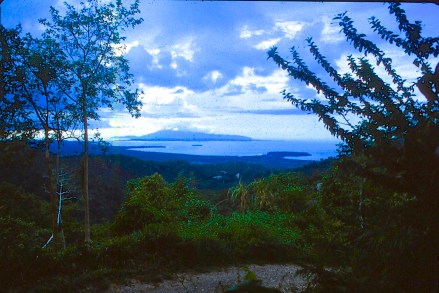
We finally arrived at Ralf’s simple home 400 meters up in the cool, breezy hills above town. The elevation provided us with a broad view of the sparkling blue bay on which sat the town of Wewak. We were shown to the small “guest room” which contained four sets of wooden plank bunk beds with a small woven mat on each. I wasn’t sure if they were for decoration or if they were intended to simulate a mattress. We were the only guests at the moment, so we had the room to ourselves. We were instructed to make ourselves at home, walk around, shower, eat, read, rest, whatever we felt like doing.
Like all the native houses in the area Ralf’s was built on top of short stilts to keep it off the wet ground. The slight elevation helped with the moisture problem but only slightly impeded the rot, roach, rodent and ant problems which each household had to contend with. Several rusted, dead, moss-covered cars with their guts half removed littered the yard making it difficult to walk into the house.
On the outside, the small, worn structure appeared shabby, and rundown, but inside it was warm and homey. There were 4 bedrooms, a kitchen, and a washroom, with a shower and sink. The water was gravity fed into the house from tanks on the roof, which caught the rain. There was no hot water for washing, but not many people minded as it felt better to bathe in the cool water when the temperatures were so high. In the kitchen, Ralf cooked on a two burner hot plate and kept his food in two refrigerators, one hot and one cold. The hot one was used to store food and other articles one didn’t want to have ruined by the moisture, or eaten by the insects or rodents. Behind a map on the wall of Papua New Guinea, lay hidden a TV and VCR. Papua New Guinea received about 6 channels, two of which were movie channels and the other four which broadcast sitcoms and drama programs from England and America.
The outhouse, which was just outside the back door, had a clean toilet seat and toilet paper! A hole in the bottom of the pit allowed liquid waste to run down the hill if the latrine became too full.
It appeared that four or five Nationals, along with Ralf’s young daughter, were currently living there, helping Ralf in exchange for room and board. One man, secreted behind a closed door with a skull and crossbones on the outside, and a computer printout on the door, which read, “anyone who enters, dies” was quite sick with malaria and had a terrible cough. We saw food delivered to the room through a partially opened door which was quickly closed as if the deliverer would get bitten by what was behind there. There was also angryyelling and mumbling coming from the other side of the wall. We couldn’t envision what kind of monster was living in there. Later, when Ralf had gone to pick up his daughter, and we were alone in the house, the door opened and the mystery creature emerged to stun us with his countenance. Our “monster” turned out to be a friendly, English speaking dwarf named Little Man who told us tales about his many years working as a cook on a tourist class riverboat which used to ply the Sepik. He had to leave that job a number of years ago due to the ill effects of his malaria.
As evening approached, meal preparation became the focus of our attention as Ralf prepared sago, ( a food from the sago palm, which looked like glue), and rice and vegetables for his tenants. For us, he made a salad, potato, tomato rice soup and bug covered greens and onions, saving us from sago until later on in the trip. The food was tasty, but a little on the sparse side for our big appetites.
We enjoyed the company, conversation and laughter of the many people who were constantly in and out of the house, and especially that of Ralf, a fascinating character, who first went to PNG in 1968 as a Catholic missionary. Our host was a serious, stern-looking man who showed little expression whether happy, sad or disgusted. He was also very structured, orderly and particular, and you got on best with Ralf if you did things his way. He was, however, extremely kind, generous, patient, and caring. A highly intelligent man, who valued the same in others, he was well read and could discuss many subjects with great knowledge, ie: world affairs; history; Papua New Guinea culture; the Bible; all aspects of nature and just about any subject you may bring up. He didn’t flaunt his knowledge, however, appearing simple and humble. One wouldn’t guess his depth without being around him for awhile and getting to know that very private man.
Ralf had three children, two grown sons, and a pretty 5 year old daughter named Theresa. Her mother, who was a National, died at Theresa’s birth as a result of a botched Caesarian-Section. Theresa had been raised by Ralf and the many relatives of her mothers who lived in the nearby village. She was expressive in her wants and needs and was a very stubborn and willful little girl. The apple of her Daddy’s eye, he had a difficult time saying no to her. She preferred the company of men to women, and took an immediate liking to Sky while totally ignoring me. She had learned very early how to charm men and get what she wanted.
We hit our plank beds early, after an exhausting, but very exciting first day of our 3 week adventure into the “Land of the Unexpected”.
Until next time: Be Wild and Fearless!!!
 Terra Lyn Joy
It is so much fun reading about your adventures, can’t wait to hear more!
LikeLike