We spent 2 weeks lounging on the beaches of East coast Malaysia before traveling to the western side of the peninsula where all the commerce, modernization and money is. The buildings are modern, there are more Chinese Malays and fewer Moslems, and women’s dress was less conservative and more westernized. The East coast, and the interior, are home to native Malays, many of which are devout Moslems where the women wear robes and head coverings.
A short ferry ride took us to Penang Island and the city of Georgetown, a place that seemed more Chinese than either Hong Kong or Singapore and was much like the places we visited in China. Most buildings had red tiled roofs, with overhangs arching over the sidewalks 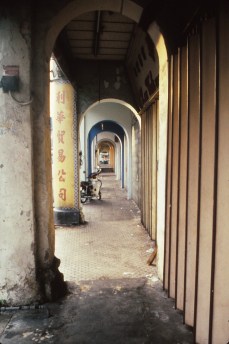 under which the Chinese shops and their customers spilled onto the covered walkway so one had to walk into the street to avoid the obstacles. There were curved roofed Chinese temples with dragons emerging from the eaves, there were Buddhist temples, Thai temples, Muslim Mosques, Hindu Temples, Christian churches and the sound of the Moslem call to prayer coming from loud speakers on top of the minarets five times a day.
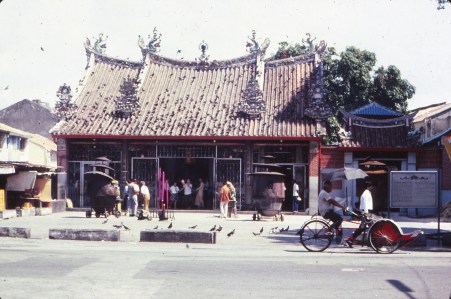
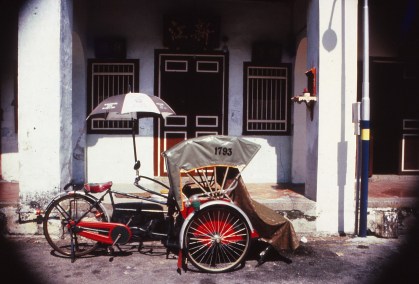
Honda motorcycles, buses, bicycles and trishaws crowded the streets and added to the noise with their horns, bells and lack of mufflers. The ever present combination of food and sewer smells permeated the air while the open sewers that ran along the edges of the
streets had to be watched for, stepped over, or walked along so one could navigate around the crowds on the sidewalks, the street traffic, the parked cars and the motorcycles.
Woven bamboo shades were hung across the shop fronts and had “doorways” fashioned into the middle of them for the
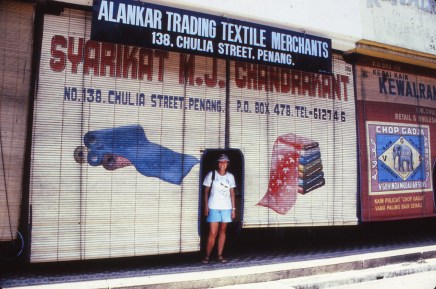
customers to walk through. The name of the shop and what was sold there was woven into the shades using colorful dies to brighten the signs.
There were food stalls with every sort of food imaginable: fruit and fruit juices, mango, guava, durian, pineapple, jack fruit, papaya, apple, orange, starfruit, mango stems, rambutan, coconuts, banana, etc. To drink, there was tea, coffee, nescafe, milo, water, soft drinks, soy milk and much more. Then there was fried rice, fried noodles with veggies, chicken, meat, fish, omelettes, soups, sweets, Indian food, Chinese food, Western food. Each morning and night the side streets were filled with food stalls, tables, and people eating, in fact it seemed that people never stopped eating! The price of the food couldn’t be beat starting at thirty cents and ranging up to $4.50.
The surrounding sea was crowded with ships, boats and floating debris while on land, the narrow streets wound between old, two and three story, cement homes where laundry hung out the windows above the family store below.
Scrawny cats with crooked half tails yowled and prowled keeping the streets clean. Bustling, busy, intense Chinese people scurried along the streets from dawn until midnight gaining energy from their detailed, perfected entrepreneurial activities. Lean or pot bellied Indian men, in plaid sarongs and sandals strolled the streets and manned their shops in a relaxed, easy going but measured fashion. Dark skinned money changers lurked in darkened alcoves, seated on high desks behind wire mesh, punching calculators and figuring ways to cash in on the traveler’s innocence.
The Chinese Hotel we were staying at was a big, square, bulky, white, cement building set back off the street behind a big white cement archway which used to be closed off by huge doors that were no longer functional. One entered a large lobby with ornately carved, square wooden chairs lining the walls, a plain table and chairs pushed up against the back of the second story stairway, an old desk topped with an old black phone, an abacus, and a “no spitting” sign. A skinny, wrinkled, old Chinese man with poor eyesight sat curled in a chair all day passively reading a Chinese language newspaper. The back of the hotel had no wall but opened into a courtyard surrounded by two ells that came off the main building. The two outside stairways climbed to the second floor of the main building. Another large room on the second floor mirrored the one below. A railed walkway stretched in front of the rooms on one ell while the other wall had blue shuttered windows which looked out on the stone courtyard below. In the courtyard there was one small tree growing in a corner and behind it was a counter and a place for cooking. Woks of various sizes and other utensils were scattered about the area.
There were some very interesting permanent residents, in addition to the grumpy Chinese proprietor. A middle aged, Oriental guitar player strummed and sang country and western and American folk tunes every evening, and most interestingly, two or three, very friendly, oriental, and/or, occidental men or women, we couldn’t figure out the sex, but were quite strange in appearance. One was thin and small with long dark hair and a deep voice who walked around with a towel wrapped around the body as a woman would. Another was a very tall and bulkily built person with a voice like a woman, also with long dark hair. There was also a third mysterious person, who we never saw, only heard singing in a beautiful haunting voice drifting from his or her second floor room. Then of course there were the other travelers that came and went but they seemed pretty quiet and uninteresting compared to the resident cast of characters who seemed as if they had just walked out of a John Irving novel.
I love the Pico Iyer quote about traveling, “the exotic becomes familiar and the familiar becomes the exotic.” This had certainly come to be for us, with much more exotic to come!!
Until next time, be wild and exotic!!!!
 Terra Lyn Joy